
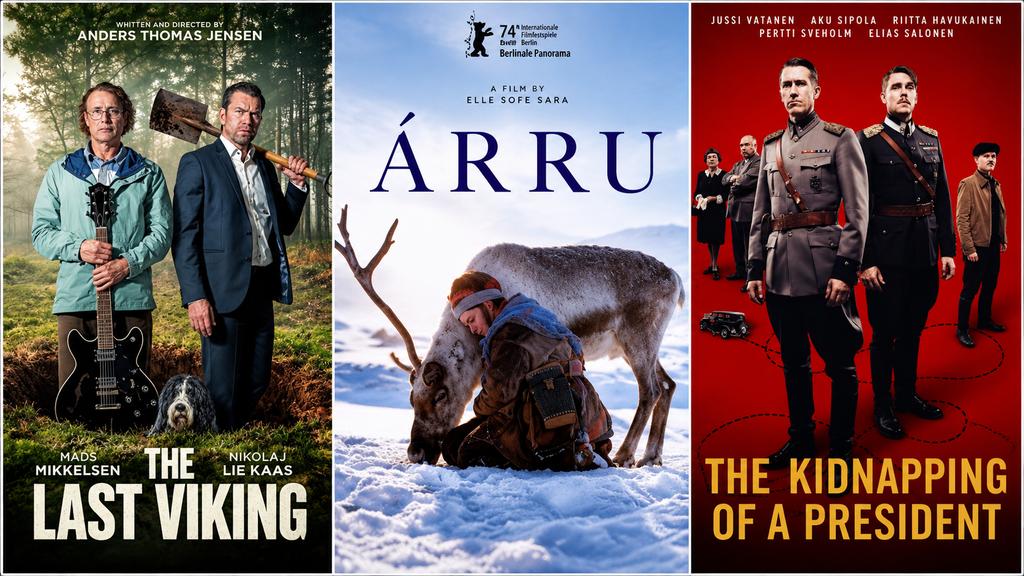
With the 2026 Nordic Film Festival Australia inviting audiences to immerse themselves in some very different cinematic worlds, three memorable films particularly arrested my attention: Finnish director Samuli Valkama’s political satire The Kidnapping of a President, Danish writer-director Anders Thomas Jensen’s darkly comic The Last Viking, and Sámi filmmaker Elle Sofe Sara’s haunting debut feature Árru, a Norwegian-Swedish-Finnish co-production.
Although vastly different in tone, all three films ask a surprisingly similar question: how do individuals hold on to truth, identity and humanity when the worlds around them begin to unravel?
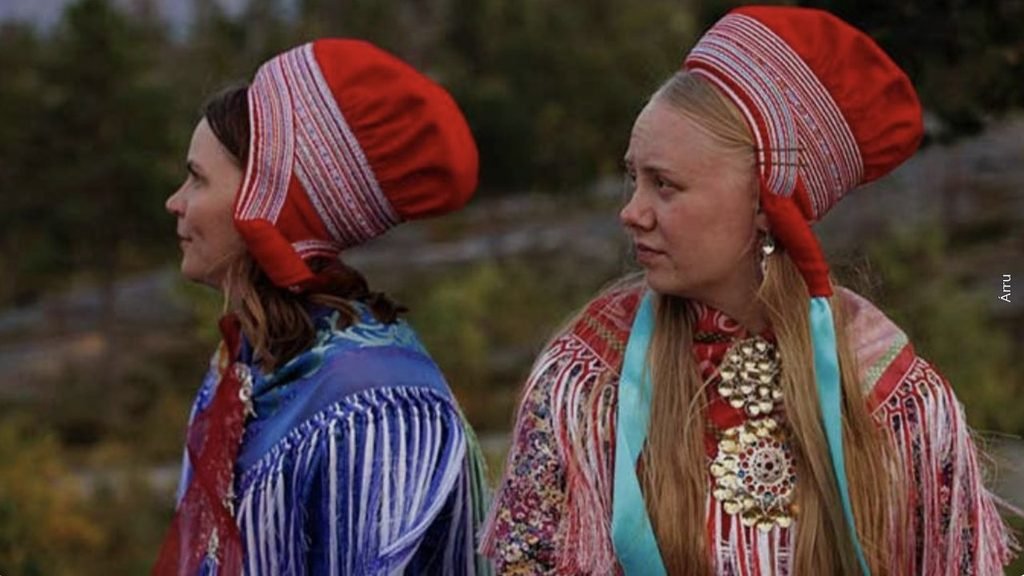
Set among the Sámi reindeer-herding community in northern Scandinavia, Árru is less a conventional drama than a landscape that refuses to be silent. The story follows a young woman returning home as her community faces the growing threat of mining interests encroaching on land that has sustained generations of reindeer herders.
The defining image for me was the sight of reindeer cantering across pristine snow, oblivious to powerful mining companies we never actually see, but whose presence hangs over every frame. The true owners of this landscape are the herds themselves, yet their future is being decided elsewhere.
Its defining sound is equally unforgettable: the heavy thud of reindeer moving through slushy snow, accompanied by bells hanging from their necks, tolling almost like a funeral ritual whose meaning neither the animals nor even their human keepers can fully comprehend.
The performances are marked by extraordinary emotional restraint. Sparse dialogue and generous silence become the language through which generations of grief, resilience and belonging are expressed. Watching from the other side of the world, I found myself drawn into a struggle whose consequences extend far beyond this remote landscape.
The film’s unresolved tension lies in what remains unseen. We never meet the mining companies. We simply know they are waiting, ready to profit from a landscape they neither understand nor truly belong to.
Inspired by true events in Finland in 1930, The Kidnapping of a President tells the astonishing story of a bungled fascist attempt to overthrow democracy. President Ståhlberg calmly declares, “I am on the side of the law,” only to discover that, for ultra-nationalists convinced democracy has failed, the rule of law itself becomes the enemy.
Director Samuli Valkama wisely avoids solemn historical drama. Instead, the coup frequently veers into absurdist comedy. The kidnappers are hopelessly incompetent. At one point they leap from their cars to threaten a herd of cattle blocking the road, dismissing them as “commie cows” while pointing rifles at them in the hope they will move aside. But the absurdity turns tragic when one of the cows is shot and bleeds to death.
The film repeatedly turns absurdist comedy into something deeply unsettling. The general leading the conspiracy insists that compassion is weakness and democracy is incapable of protecting the nation. His speeches sound disturbingly familiar nearly a century later.
The film’s closing captions make the story even stranger. Some conspirators served little or no prison time. One later became a respected military historian. The coup’s architect eventually ended his career writing children’s books. I left the cinema wondering whether history’s warnings are ever recognised before they become history.

The Danish-Swedish co-production The Last Viking takes us into completely different territory. What begins as an eccentric family story gradually reveals itself as an exploration of trauma, memory and healing.
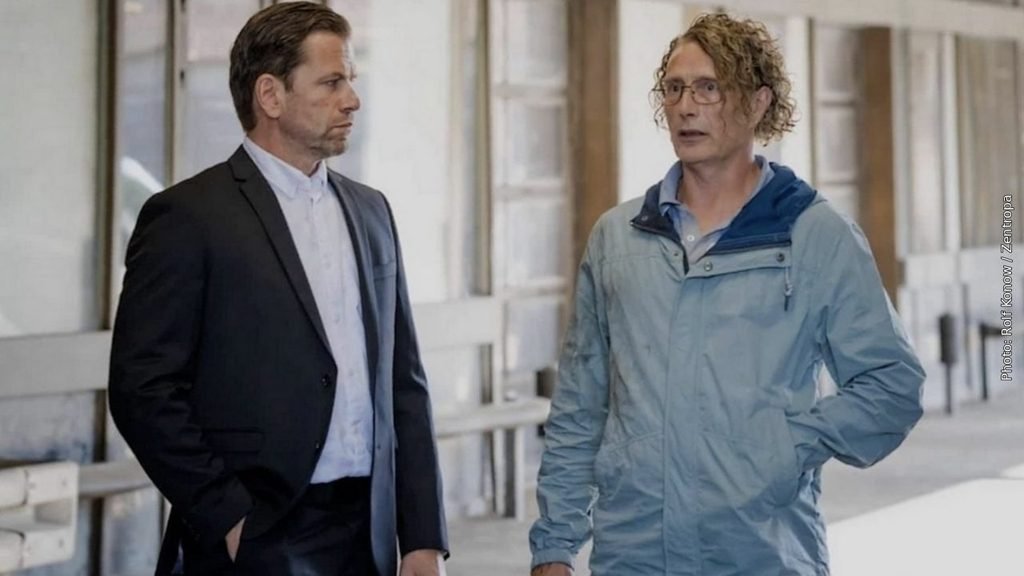
Two brothers, shaped by a violently authoritarian father who taught them that “a Viking does not show emotion”, struggle to escape emotional wounds that continue to define their lives. One has adopted the persona of John Lennon, suggesting that imagination itself can become a means of survival.
The film mixes black comedy, crime thriller and emotional drama with remarkable confidence. Some critics have found its tonal shifts unsettling; others praised precisely that unpredictability as the source of its humanity. For me, the film’s most intriguing question is whether self-delusion can sometimes become the first step towards recovery.
What ultimately links these three films is not their plots but their exploration of competing realities — and the struggles for power that determine whose version prevails.
In Árru, commercial interests seek to impose their definition of progress upon an Indigenous community. In The Kidnapping of a President, extremists seek to enforce their political vision through violence. In The Last Viking, the struggle becomes intensely personal, as constructing an alternative reality becomes a defence against unbearable trauma.
Across all three films, absolute convictions become dangerous when they leave no room for other people’s experiences. Mining interests are certain of the value of extracting raw materials. Fascists are convinced that they are uniquely entitled to rule over others. And a damaged family has been shaped by a father’s brutally enforced beliefs about what constitutes masculinity.
What emerges across all three films is that the most destructive characters are often those least troubled by doubt.
From reindeer threatened by mining companies to fascists shooting communist cows and a Viking who adamantly believes he is John Lennon, these distinctly Nordic narratives remind us that reality is stranger than fiction — and considerably more dangerous.